Aerandil builds the systems a property runs on, from the front desk to the restaurant to the bill, all on one governed record of the operation. Ithaca, our property management system, is the first.
Hotels run on systems. Operators run between them.
A property runs a PMS, a point of sale, a channel manager, a payment terminal, a housekeeping sheet and a spreadsheet for whatever is left. Each one invents its own guest, its own room and its own bill. The desk re-keys between them, and the record of what happened lives nowhere.
The old modelEvery application rebuilds the hotel. Business rules drift into screens, scripts and spreadsheets, and no two systems agree on who is in room 108.
The Aerandil modelModel the operation once. A reservation is a typed object connected to a person, a property, a room type, a rate plan, inventory, a stay and a folio, with rules governing how it can change.
The productsBuilt on the same model
Forge is the platform. Ithaca runs the desk. The rest is built the same way.
Arrivals, departures, housekeeping from a phone, the money in both directions, and a night audit that says what is in the way. Built one screen at a time, against a hotel with guests in it.
A minute at the front deskRecorded on Ithaca itself. The guests are made up; every click is the real product.
Demonstrable today, with its first hotels; not yet generally available.
Counted from the registry, not the brochure. Regenerated with every schema change.
Under every screenForge, the platform
One model under every screen.
Ithaca has no private door. Every board writes through the same typed, permissioned, validated actions the platform exposes to any integrator, SDK or agent. The audit trail is not a feature of the product. It is the only way anything gets written.
forge.aerandil.com
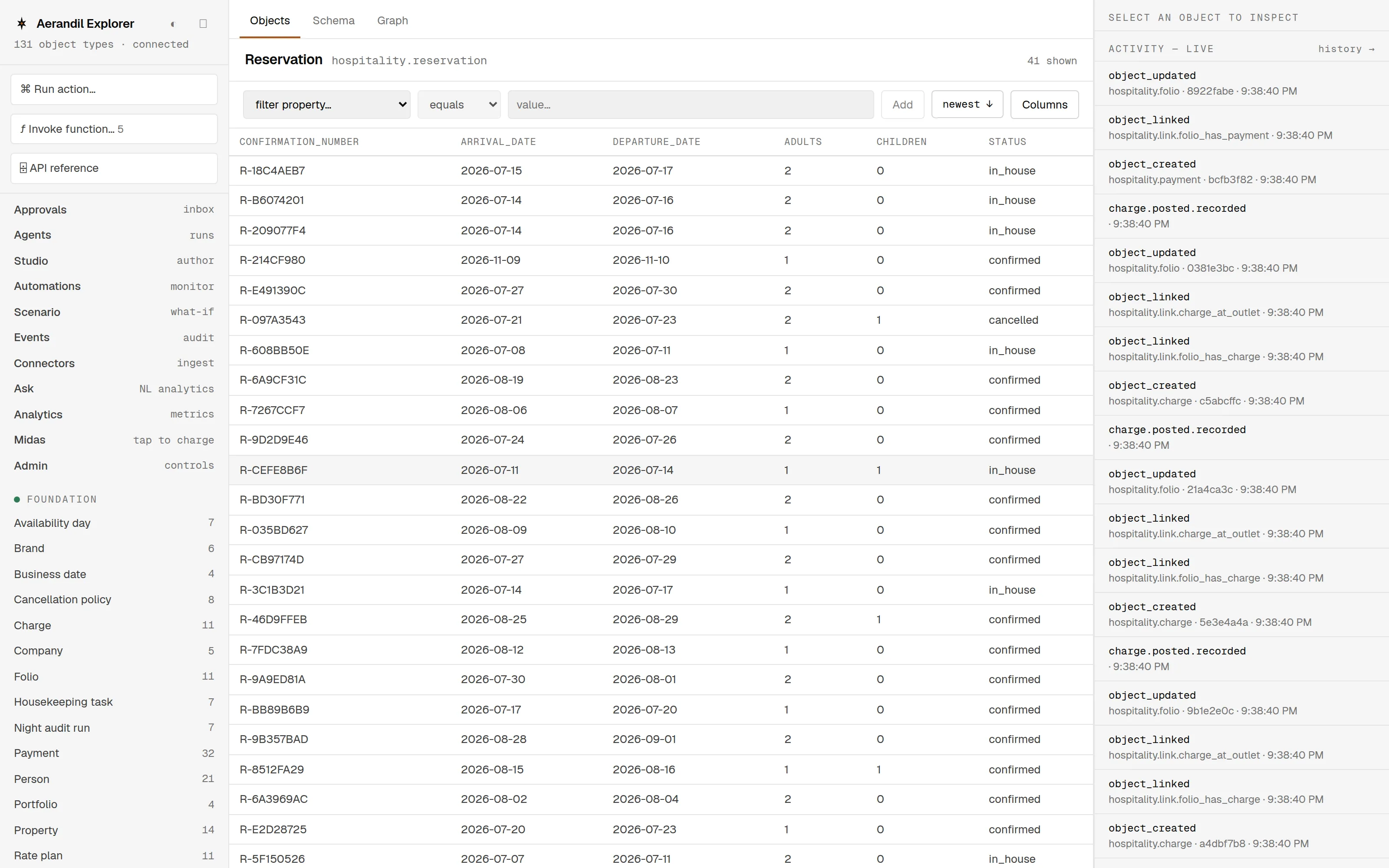
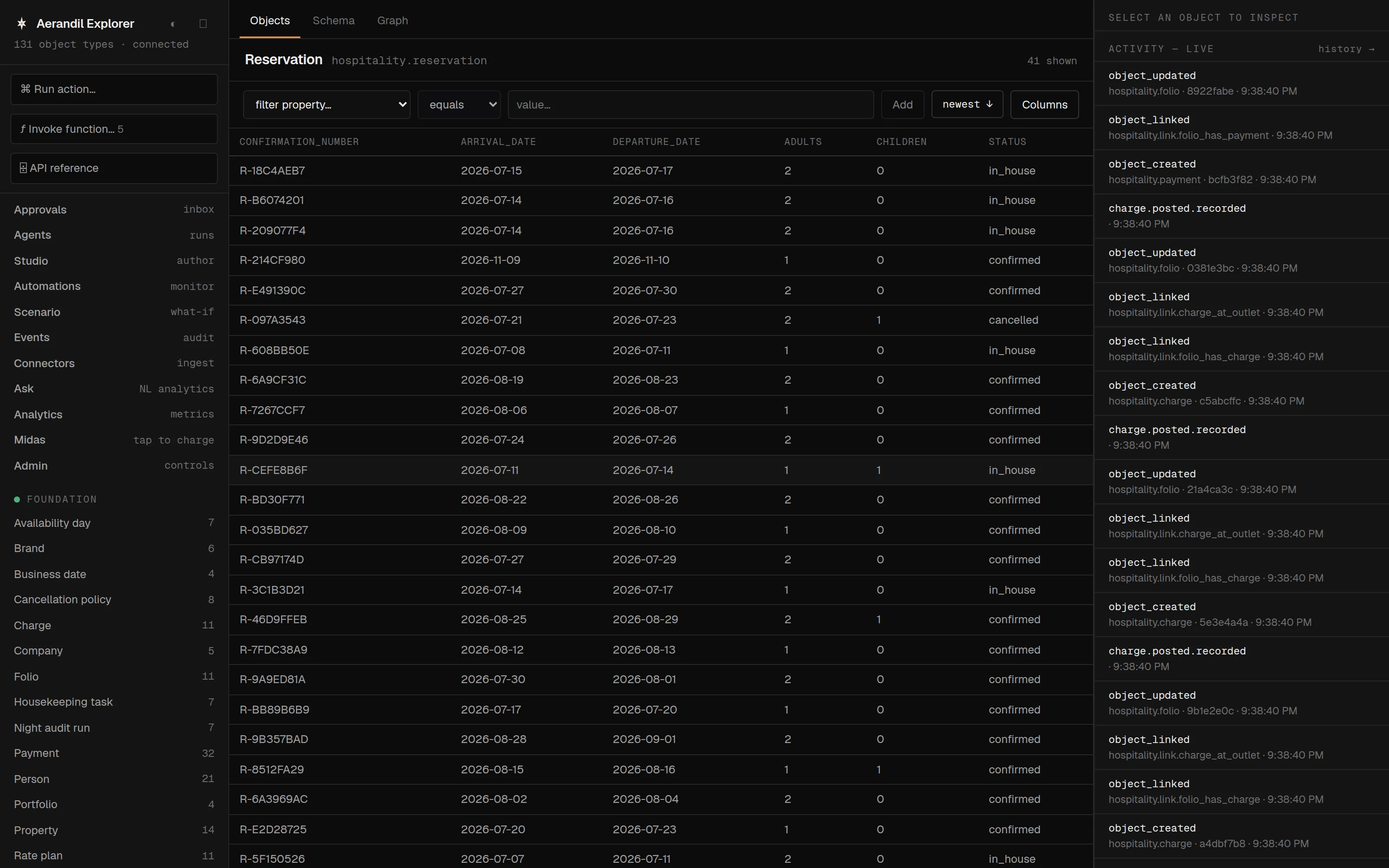
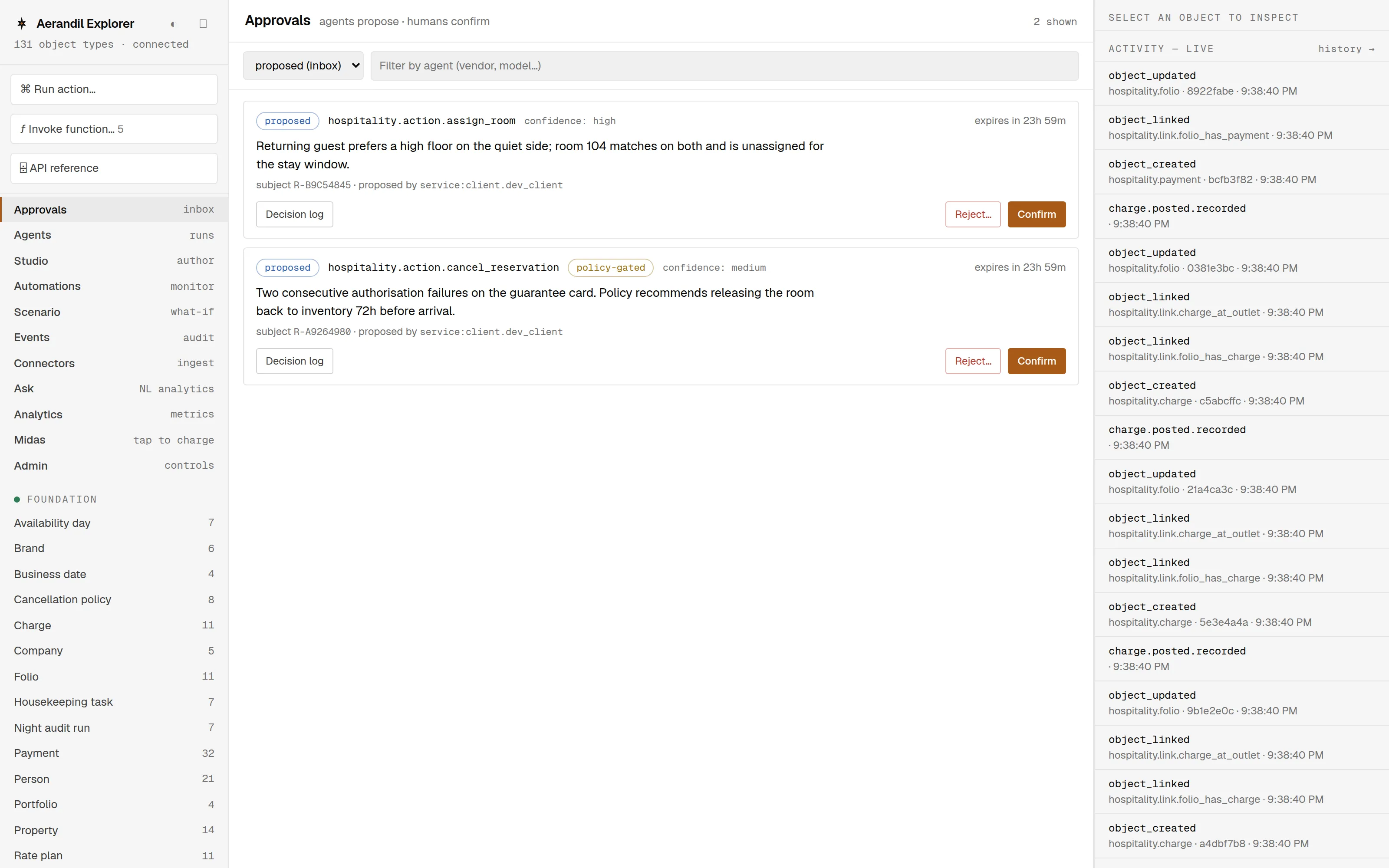
Explorer, the platform's console: every object, link, action and event in the ontology, live.
Typed operationsObjects, links, actions and functions carry declared contracts. The model is executable, not a diagram.
Governed changeEvery mutation is permissioned, validated, idempotent, and recorded as an immutable event.
Open foundationsVanilla Postgres, OpenAPI, JSON Schema, MCP and generated SDKs. Nothing here needs us to stay portable.
A design partner does not start by switching systems. Connectors read what the property already runs, and the model fills from the record as it stands.
01ExtractConnectors pull from the systems you already run — PMS, POS, workforce, procurement — on their own schedules.
02Land verbatimEvery vendor record is staged raw, exactly as it arrived. Nothing is dropped or coerced at the door.
03Fold through actionsVersioned mappings replay each record through the same governed actions as every operator — validated, idempotent, audited.
Every sync run is an audited object in the same ontology it feeds. How ingestion works ->
Design principle
AI acts through the same rules as everyone else.
An agent's tools are ontology operations: typed, permissioned, validated, audited. When confidence is low or the stakes are high, the agent proposes and a person confirms.
# a governed action — not raw database access
POST /v1/actions/apply → validate → event# one path: the desk, an integrator, an agent
Our flagship agent lives by these rules. Meet Talos ->
forge.aerandil.com
Questions
What a first call asks.
Answers checkable in the product or the docs. The rest is a conversation.
What is Aerandil?
One governed model of a hotel's operation: the guests, rooms, bookings, bills, staff and suppliers, and every change to them, made through a typed, permissioned action and kept on an append-only record. Our products are built on it. Your own systems connect to it through the same contracts.
What is Ithaca?
Our property management system: the front desk from arrivals to the night audit, a phone app for housekeeping and maintenance, and payments on the same bill as the stay. It is in early access with its first hotels, demonstrable today and not yet generally available.
How do we become a design partner?
Apply on the design partner page. You get three times for a fifteen-minute call straight away; after it we shadow your property from your current system, you run a private demo on your own data, and go-live is rehearsed before the night. The first three months are at cost.
Do we have to replace our PMS to start?
No. Connectors read what the property already runs and the model fills from the record as it stands. Switching is a later decision, and when a hotel makes it we rehearse the cutover against its own data before the day.
How does AI fit in?
An agent's tools are the same actions the desk uses, with the same permissions, validation and audit. Where the stakes are high or the confidence is low, the agent proposes and a person confirms. Nothing is written any other way.
Where does our data live?
In vanilla Postgres, portable to any host. With Proxima it runs in a single-tenant cell of your own, in the region and jurisdiction you choose, with residency enforced by the model rather than by policy.
What does it cost?
Ithaca is priced per room per month, with no setup fee. The figure is agreed with design partners during early access and published at general availability.
Forward deployed
Building the operational foundation hospitality is missing.
Aerandil is in private development. The first hotels run Ithaca with us on site, as design partners, and their day shapes what the model learns next. A private demo is where that starts: we set up a hotel shaped like yours and work the day with you, live.